Plusletherel
Anchor Blueprint
Anchor Blueprint
Couldn't load pickup availability
1. Problem Statement
As C++ programs grow to include multiple classes, learners encounter questions about how those classes should relate to one another and how responsibilities should be distributed between them. Organizing similar behaviors across separate objects can lead to repeated instructions, complicated relationships, and difficulties understanding how different components communicate. Inheritance and polymorphism introduce new concepts that require careful attention to function behavior, object types, and the structure of class hierarchies. Abstract classes and virtual functions add further considerations about how shared interfaces can represent different implementations. Without a clear understanding of these relationships, reading and organizing class-based programs can become increasingly complicated.
2. Solution
Anchor Blueprint introduces structured approaches to C++ class architecture through focused explanations and practical programming examples. Each module examines a particular relationship between classes and demonstrates how that relationship influences program behavior. Annotated code examples illustrate inheritance, virtual functions, abstract classes, and the interaction between objects with different responsibilities. Guided exercises invite learners to examine class hierarchies, interpret method calls, and consider alternative ways of organizing related components. The course concludes with a structured programming assignment that combines several class-design concepts into one connected example.
3. What's Inside
Anchor Blueprint contains nine instructional modules covering C++ class relationships, interface organization, object behavior, and introductory architectural decisions.
The materials include written explanations, class diagrams, annotated examples, programming worksheets, and a concluding practical assignment.
Module 01 — Building a Class Structure
The opening module revisits the organization of classes and examines how larger programming tasks can be divided into related components.
Learners explore class responsibilities, public interfaces, private data members, and the relationship between stored information and member functions.
Examples compare classes containing unrelated operations with alternatives where responsibilities are divided between separate components.
The practical activity invites learners to examine a small class collection and describe the purpose of each component.
Module 02 — Understanding Inheritance
This module introduces inheritance as a mechanism for representing relationships between related classes.
Learners examine base classes, derived classes, inherited members, and the distinction between shared and specialized behavior.
Annotated examples demonstrate how a derived class can build upon a base class definition while introducing its own members.
The materials also discuss public inheritance and the visibility of inherited class members.
Practice exercises involve interpreting inheritance diagrams and identifying relationships between class definitions.
Module 03 — Exploring Polymorphic Behavior
Polymorphism introduces the ability to work with different object types through a shared interface.
This module examines virtual functions and dynamic dispatch through examples involving related classes.
Learners observe how a virtual function call can invoke different implementations according to an object's runtime type.
The lessons also distinguish between ordinary member functions and virtual functions.
Code-reading activities invite learners to predict program behavior and identify which function implementation is selected during execution.
Module 04 — Abstract Classes and Shared Interfaces
This section introduces abstract classes and pure virtual functions.
Learners examine how an abstract base class can describe operations that derived classes are expected to implement.
Examples demonstrate shared interfaces for different categories of objects, including records that perform related operations in different ways.
The module explains why an abstract class cannot be instantiated directly and how concrete derived classes provide implementations.
A guided exercise asks learners to interpret an abstract interface and describe the responsibilities of its derived classes.
Module 05 — Constructors Across Class Hierarchies
Object initialization becomes more detailed when inheritance is involved.
This module explores constructor execution order, initialization of base-class members, and the relationship between base and derived constructors.
Learners also examine destructor behavior in polymorphic class hierarchies and the role of virtual destructors.
Annotated examples demonstrate object creation and destruction across related class types.
Practice worksheets focus on tracing constructor calls and interpreting the lifetime of objects within class hierarchies.
Module 06 — Composition or Inheritance?
Not every relationship between classes should be represented through inheritance.
This module compares inheritance with composition, where one class contains objects of another class.
Learners examine examples showing how each approach represents a different type of relationship.
The materials discuss how class responsibilities, shared behavior, and object ownership influence architectural choices.
Exercises ask learners to review class diagrams and explain whether a relationship represents containment or specialization.
Module 07 — Organizing Class Interfaces Across Files
This section examines how related class declarations and implementations can be organized within a larger C++ project.
Topics include header files, source files, declarations, definitions, and dependencies between components.
Learners explore examples containing several classes distributed across separate files.
The module introduces forward declarations and explains their role in describing relationships between class types.
A guided activity involves examining a collection of class declarations and identifying how individual components relate to one another.
Module 08 — Examining Class Design Decisions
This module encourages learners to evaluate the structure of existing object-oriented code.
Topics include class responsibilities, repeated operations, interface clarity, and relationships between individual components.
Annotated examples compare alternative ways to organize the same programming task.
Learners examine how changing a class interface can influence other sections of a program.
Exercises involve reading class diagrams, identifying responsibilities, and outlining possible structural revisions.
Module 09 — A Connected Class Architecture
The concluding module combines the course concepts in a structured programming example.
Learners examine a small record-management system containing a shared abstract class and several derived classes.
Each derived class represents a different record category and provides its own implementation of selected operations.
The example also includes a separate collection component responsible for organizing and examining records.
The assignment is divided into stages covering class declarations, inheritance relationships, virtual methods, object creation, and program interaction.
Review questions encourage learners to explain why each class exists and how it contributes to the overall structure.
Additional Course Materials
Anchor Blueprint includes supporting materials for examining the topics introduced throughout the lessons:
-
Annotated Programming Examples: Code explanations focused on inheritance, polymorphism, and class interaction.
-
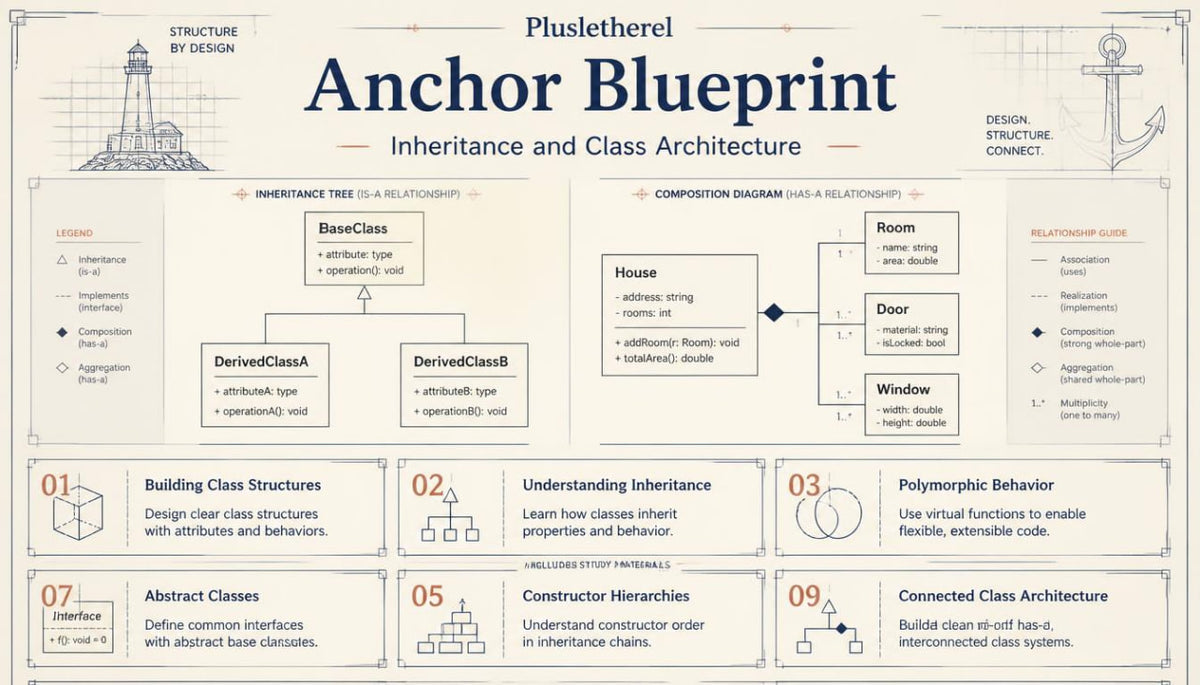
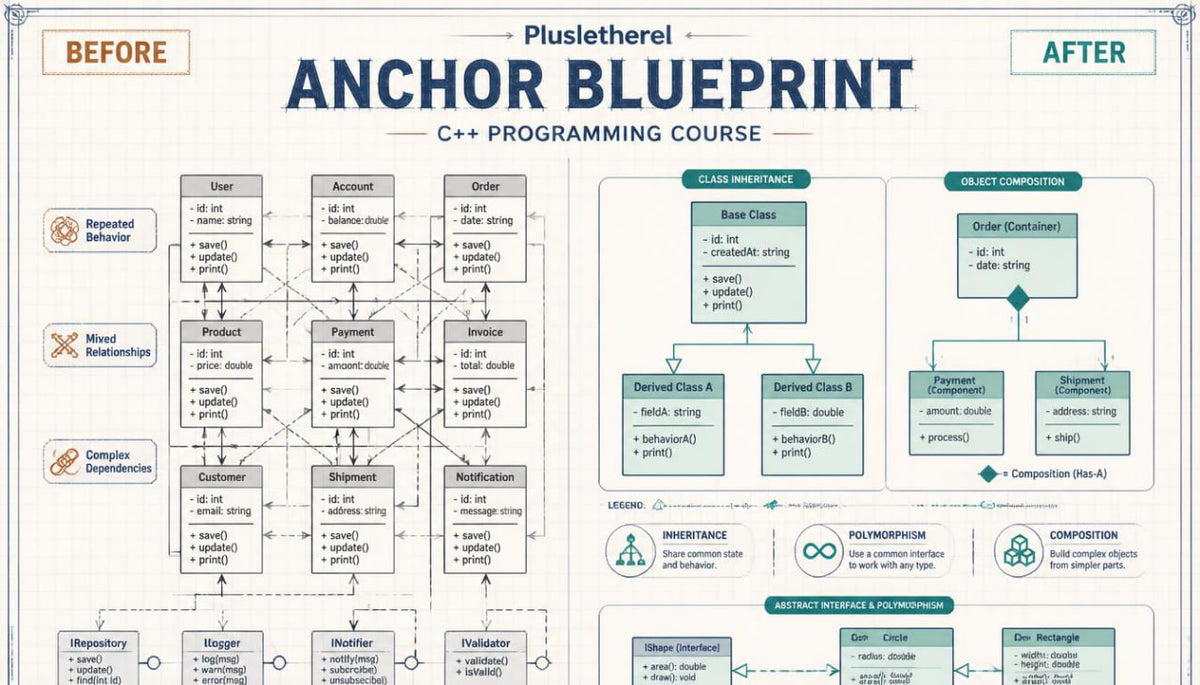
Class Relationship Diagrams: Visual representations of base classes, derived classes, and object composition.
-
Virtual Function Exercises: Activities examining method overriding and runtime behavior.
-
Constructor Tracing Worksheets: Tasks focused on object initialization and destruction order.
-
Interface Design Notes: Written explanations of public interfaces and class responsibilities.
-
Architecture Comparison Exercises: Activities comparing inheritance and composition.
-
Code Organization Reference: Notes covering declarations, definitions, and relationships between files.
-
Module Review Questions: Questions about object-oriented terminology and program structure.
-
Concluding Programming Assignment: A connected class-based example bringing together multiple course concepts.
4. Who Is This For?
Learners Continuing Their C++ Studies
Anchor Blueprint is intended for individuals familiar with classes, constructors, member functions, and introductory object-oriented concepts who want to examine more detailed relationships between class types.
Students Exploring Class Architecture
The course may suit learners interested in understanding how multiple classes can form connected structures with distinct responsibilities.
Readers Interested in Polymorphism
The materials provide focused explanations of virtual functions, abstract classes, and the behavior of objects represented through shared interfaces.
Independent Learners Working With Larger Examples
The written lessons, diagrams, and exercises support individuals who prefer examining interconnected programming components through structured study.
5. What You'll Learn
Through the written materials and practical activities, learners can explore the following C++ concepts:
-
Identify responsibilities within a collection of related classes.
-
Explain relationships between base and derived classes.
-
Interpret public inheritance and inherited class members.
-
Describe how virtual functions influence method selection.
-
Examine polymorphic behavior through base-class references and pointers.
-
Distinguish between ordinary and virtual member functions.
-
Interpret abstract classes and pure virtual declarations.
-
Explain the role of shared interfaces in class hierarchies.
-
Trace constructor execution across inherited classes.
-
Describe the purpose of virtual destructors.
-
Compare inheritance with object composition.
-
Examine class dependencies across header and source files.
-
Interpret forward declarations and their relationship to class organization.
-
Read diagrams representing connected class structures.
-
Analyze alternative approaches to organizing object-oriented programs.
-
Combine inheritance, composition, and virtual methods in a guided programming assignment.
The curriculum emphasizes understanding C++ class relationships and examining the design decisions behind interconnected program structures.
6. 30-Day Refund Policy
Anchor Blueprint follows a 30-day refund request period.
Customers may submit a refund request within 30 days of purchasing the course, subject to the conditions described in the published Plusletherel Refund Policy.
The policy provides information about eligibility, submitting requests, and the procedure used to review refund inquiries.
Customers are encouraged to examine the course curriculum, included materials, and refund conditions before completing their order.
The stated refund arrangement concerns the terms of purchase and does not establish a commitment regarding individual learning results or completion timelines.
Anchor Blueprint is intended for independent educational study through written C++ lessons, annotated programming examples, and practical assignments. Individual learning progress depends on previous knowledge, study schedules, and engagement with the course materials.
- 📥 Digital file available after purchase
- 📚 Long-term availability
- 🔒 Secure checkout
- 📅 Content updated in 2026
Self-paced learning overview
What is included in a Plusletherel C++ course?
What is included in a Plusletherel C++ course?
Each course contains structured educational materials focused on selected C++ programming topics. Depending on the course tier, the materials may include written lessons, code examples, guided exercises, reference notes, and practical assignments. Individual course descriptions provide details about the subjects and learning activities included.
Can I study the materials at my own pace?
Can I study the materials at my own pace?
Yes. Plusletherel courses are designed for independent study, allowing learners to read explanations, examine programming examples, and revisit previous sections according to their own schedules. You can spend additional time exploring individual concepts before moving to another topic.
How do the different course tiers compare?
How do the different course tiers compare?
The course collection follows a gradual progression from introductory programming concepts to more detailed C++ topics. Each tier introduces a particular selection of subjects, exercises, and educational materials. Learners can review the curriculum of each course to identify the topics that correspond to their existing knowledge and interests.
Share