Plusletherel
Free Capsule
Free Capsule
Couldn't load pickup availability
1. Problem Statement
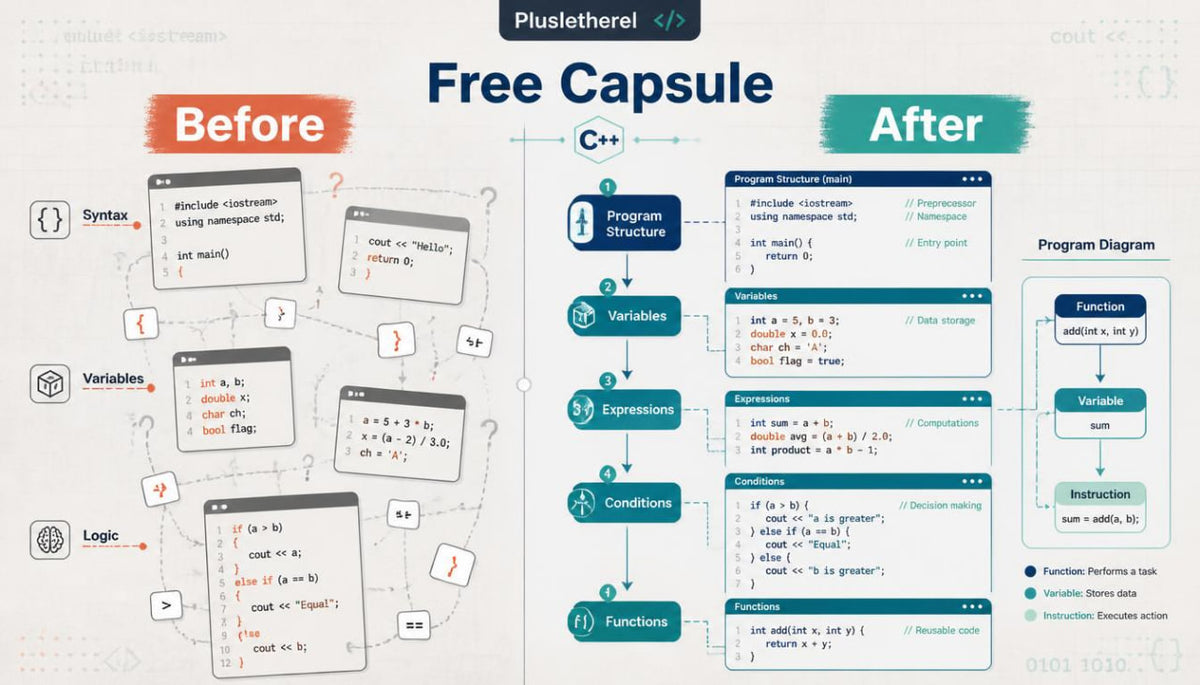
When someone begins exploring C++, even a short piece of code can contain several unfamiliar elements, including keywords, punctuation, data types, and rules that influence how instructions behave. Reading these elements without understanding their individual purposes can make it difficult to follow the logical structure of a program. Variables, expressions, and basic operations introduce additional questions about how information is stored, changed, and interpreted. Conditional statements and loops require learners to consider the order in which instructions are executed and how different conditions influence that sequence. Without an organized introduction, these connected concepts can become difficult to examine as part of a coherent programming process.
2. Solution
Free Capsule approaches introductory C++ topics through a structured sequence of written explanations and practical examples. Each section introduces a particular concept, examines its role within a program, and demonstrates its use through carefully selected code fragments. Annotated examples illustrate how syntax, values, and logical operations contribute to different programming behaviors. Guided exercises invite learners to examine existing instructions, identify relationships between statements, and experiment with small changes. The course provides a starting point for independent study while leaving room for learners to revisit explanations and explore individual topics in greater detail.
3. What's Inside
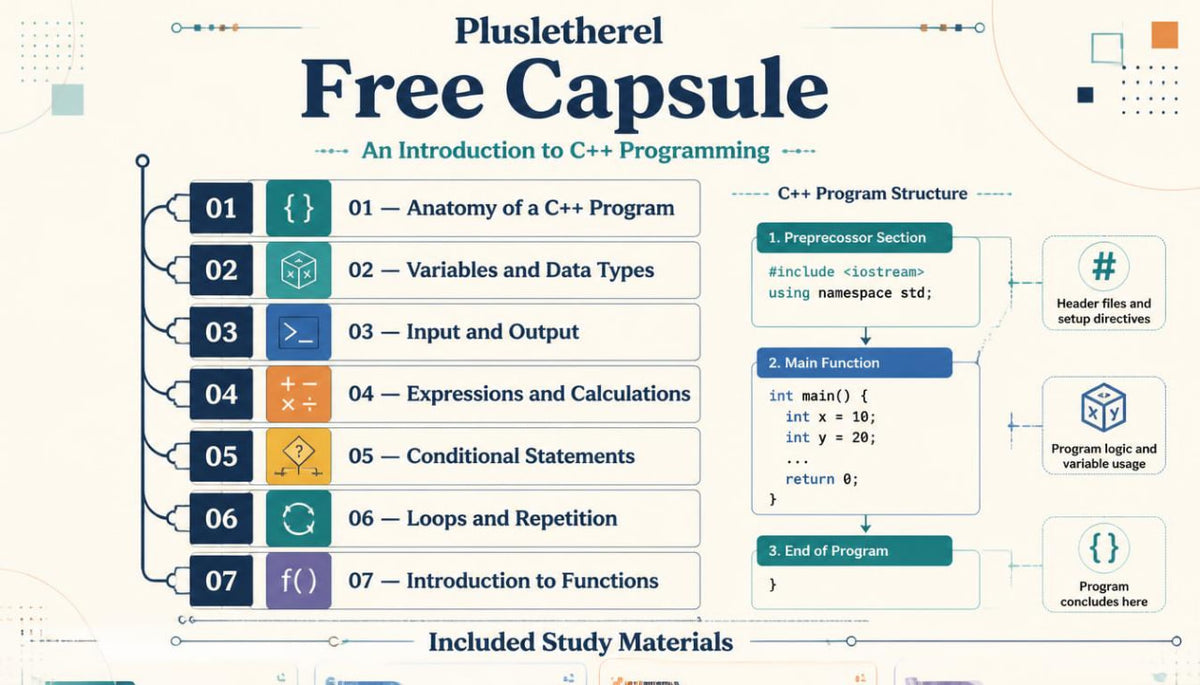
Free Capsule contains introductory learning modules, illustrated code explanations, practice activities, and reference materials organized around the foundations of C++ programming.
Module 01 — Anatomy of a C++ Program
The opening module introduces the structure of a basic C++ program. Learners examine the purpose of the entry point, statement boundaries, curly braces, and the arrangement of instructions. Annotated examples identify individual components and explain their relationship to the surrounding code. A short reading activity invites learners to describe the purpose of selected lines before examining their behavior.
Module 02 — Variables, Values, and Data Types
This section explores how programs represent and organize information. Topics include variable declarations, assigning values, naming conventions, integers, decimal values, characters, and Boolean expressions. Examples demonstrate how different types correspond to different categories of information. Practice questions focus on identifying declarations, interpreting assignments, and observing how values change within a sequence of instructions.
Module 03 — Working With Input and Output
Learners are introduced to basic interactions between a program and its surrounding environment. The materials describe how information can be displayed and how input values can be read for use in calculations or decisions. Annotated examples explore the relationship between instructions and displayed results. A small exercise asks learners to examine an interaction involving a name, a numerical value, and a corresponding response.
Module 04 — Expressions and Calculations
This module examines how C++ combines values and operators to form expressions. Learners study arithmetic operations, assignment statements, comparison operators, and the role of parentheses in determining evaluation order. Examples present small calculations and invite readers to determine their results. The exercises also introduce the distinction between calculating a value and checking whether a particular condition is true.
Module 05 — Decisions in Code
Conditional statements introduce the idea that different instructions can run depending on the information available. This module examines if, else, and related conditional structures through examples involving numerical comparisons and simple decisions. Learners follow the execution path of each example, identify which branches apply, and consider how changing a condition affects the result.
Module 06 — Repetition and Loops
This section introduces repeated execution through basic loop structures. The materials discuss loop conditions, counters, and the relationship between initialization, repeated instructions, and termination. Learners examine examples that count values, repeat calculations, and process short sequences. Practice activities encourage readers to predict the number of repetitions and identify how loop conditions influence program behavior.
Module 07 — An Introduction to Functions
The final instructional module introduces functions as a way to organize related instructions. Learners explore function names, parameters, return values, and simple function calls. Annotated examples demonstrate how a calculation can be placed inside a function and used elsewhere in a program. The module concludes with a small exercise involving a function that processes numerical input.
Additional Study Materials
Alongside the instructional modules, Free Capsule includes supporting resources for reviewing introductory concepts:
-
Code Reading Notes: Short explanations highlighting the purpose of selected statements and symbols.
-
Practice Worksheets: Exercises involving variable identification, expression evaluation, and program-flow interpretation.
-
Syntax Reference: A compact reference covering introductory keywords, operators, and statement structures.
-
Review Questions: Questions that invite learners to describe concepts in their own words.
-
Mini Programming Activity: A small exercise combining variables, calculations, and conditional logic into one program.
These materials are arranged to support repeated reading, independent experimentation, and reflection on the concepts introduced throughout the course.
4. Who Is This For?
People Exploring Programming for the First Time
Free Capsule is intended for individuals who are curious about how programming instructions are written and interpreted. The introductory explanations begin with basic terminology and gradually introduce relationships between statements, values, and control structures.
Learners Interested in C++ Syntax
The course may suit readers who want to examine C++ language elements before studying more detailed programming topics. Annotated examples provide opportunities to observe how punctuation, operators, keywords, and statements are combined.
Independent Learners
Those who prefer studying through written explanations and practical exercises can follow the material according to their schedules. Sections can be revisited when a concept requires additional consideration.
Readers Reviewing Fundamental Concepts
Free Capsule can also serve as a short reference for individuals returning to introductory C++ topics. Its examples and exercises provide opportunities to review terminology and basic program structures.
5. What You'll Learn
Through the course materials and exercises, learners can explore the following knowledge areas and practical activities:
-
Identify the principal components of a basic C++ program and describe their roles.
-
Recognize common syntax elements, including braces, semicolons, operators, and keywords.
-
Describe how variables are declared, assigned values, and used within expressions.
-
Distinguish between introductory data types and their representation of information.
-
Examine basic input and output statements and interpret their behavior.
-
Evaluate simple arithmetic expressions and understand the order of operations.
-
Interpret comparison expressions and their Boolean results.
-
Follow conditional branches and explain why particular instructions execute.
-
Trace loop iterations and identify the conditions that control repetition.
-
Recognize the structure of simple functions, including parameters and return values.
-
Read short C++ examples and describe the relationships between their instructions.
-
Apply introductory concepts in a small programming exercise combining several topics.
The focus is on understanding fundamental terminology, examining code behavior, and developing familiarity with the structures introduced in the lessons.
6. Guarantee — 30-Day Money-Back Policy
Free Capsule is provided without a course fee. There is no payment required for this introductory course, so there is no charge to refund.
For paid courses in the Plusletherel collection, a 30-day money-back policy applies according to the terms described in the store's published Refund Policy.
Risk-free introductory study: For Free Capsule, this refers specifically to the absence of a course fee. It does not imply a particular learning result, completion timeframe, or compatibility with every individual study environment.
The course is intended as an introductory educational resource, with its learning topics and included materials described in the sections above.
- 📥 Digital file available after purchase
- 📚 Long-term availability
- 🔒 Secure checkout
- 📅 Content updated in 2026
Self-paced learning overview
What is included in a Plusletherel C++ course?
What is included in a Plusletherel C++ course?
Each course contains structured educational materials focused on selected C++ programming topics. Depending on the course tier, the materials may include written lessons, code examples, guided exercises, reference notes, and practical assignments. Individual course descriptions provide details about the subjects and learning activities included.
Can I study the materials at my own pace?
Can I study the materials at my own pace?
Yes. Plusletherel courses are designed for independent study, allowing learners to read explanations, examine programming examples, and revisit previous sections according to their own schedules. You can spend additional time exploring individual concepts before moving to another topic.
How do the different course tiers compare?
How do the different course tiers compare?
The course collection follows a gradual progression from introductory programming concepts to more detailed C++ topics. Each tier introduces a particular selection of subjects, exercises, and educational materials. Learners can review the curriculum of each course to identify the topics that correspond to their existing knowledge and interests.
Share