Plusletherel
Loom Pattern
Loom Pattern
Couldn't load pickup availability
1. Problem Statement
As C++ programs become more complex, learners encounter situations where multiple operations must be coordinated rather than performed through a single sequential flow of instructions. Working with threads introduces questions about execution order, shared information, and the interaction between independently running tasks. Synchronization mechanisms require careful examination because different operations may attempt to read or modify the same information during overlapping periods of execution. Asynchronous programming adds further considerations involving task completion, communication between components, and the management of resources during concurrent operations. Without a structured understanding of these relationships, interpreting multithreaded programs and identifying the causes of unexpected behavior can become particularly challenging.
2. Solution
Loom Pattern introduces concurrent programming through a sequence of C++ lessons that connect familiar program structures with threading and synchronization techniques. Each module examines a specific mechanism and demonstrates its behavior through annotated examples, execution diagrams, and practical activities. Learners explore how threads are created, how shared information is coordinated, and how asynchronous operations communicate their results. Guided exercises invite readers to trace execution scenarios, examine synchronization requirements, and compare different approaches to organizing concurrent tasks. The concluding assignment brings these concepts together through a structured example involving multiple operations, shared resources, and coordinated task completion.
3. What's Inside
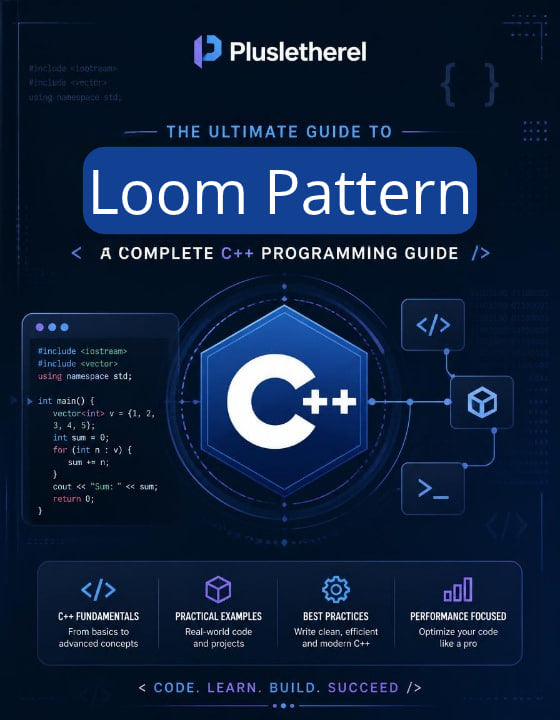
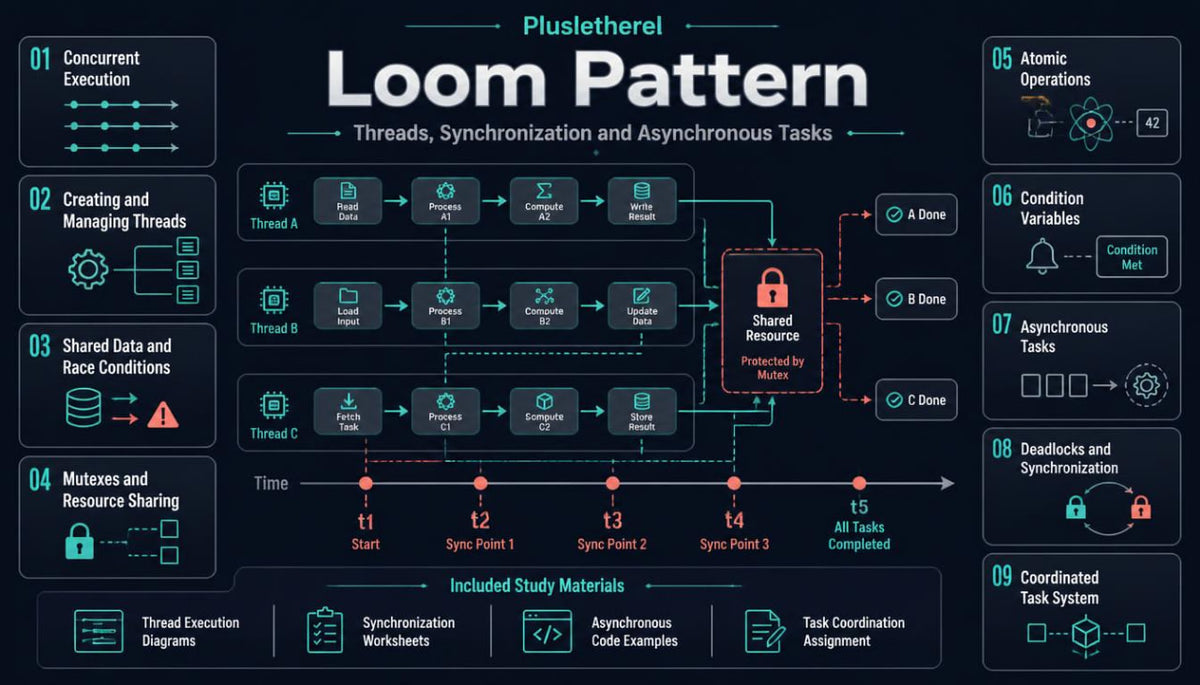
Loom Pattern contains nine instructional modules covering multithreading, concurrent execution, synchronization, asynchronous programming, and practical task coordination.
The curriculum includes written technical explanations, annotated code examples, thread interaction diagrams, programming worksheets, and a concluding practical assignment.
Module 01 — Understanding Concurrent Execution
The opening module introduces concurrency and examines how multiple tasks can make progress during overlapping periods.
Learners compare sequential and concurrent execution, exploring the relationship between tasks, threads, and program instructions.
Annotated examples demonstrate how execution order may vary between different runs.
The module also distinguishes concurrency from parallel execution and explains why the two concepts are related but not identical.
A guided activity asks learners to interpret execution timelines and identify relationships between individual tasks.
Module 02 — Creating and Managing Threads
This module introduces thread management using std::thread.
Learners examine thread creation, function execution, thread joining, and the responsibilities associated with thread lifetime.
Examples demonstrate how separate functions can execute on different threads and how the main execution flow can coordinate their completion.
The materials also introduce std::jthread and its automatic joining behavior.
Practice activities involve tracing thread creation and identifying suitable points for coordinating task completion.
Module 03 — Shared Data and Race Conditions
Concurrent operations can interact through information shared between different threads.
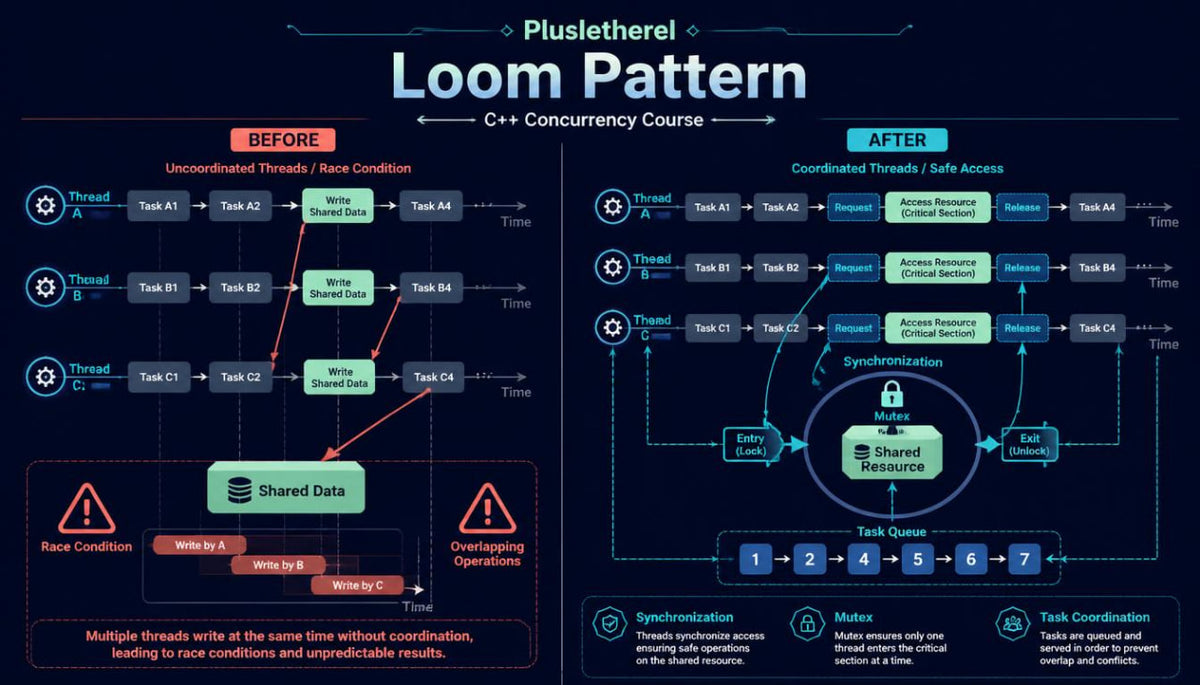
This module examines shared variables, conflicting operations, and data races.
Learners explore examples where several threads read or modify related values.
The explanations demonstrate why an apparently straightforward operation may consist of several steps that interact with other threads.
Code-reading exercises invite learners to identify unsynchronized shared-data operations and describe possible execution scenarios.
Module 04 — Mutexes and Controlled Resource Sharing
This section introduces mutexes as mechanisms for coordinating operations involving shared resources.
Learners examine std::mutex, locking operations, and critical sections.
Annotated examples demonstrate how mutual exclusion can prevent overlapping modifications to shared information.
The module introduces std::lock_guard and std::scoped_lock as tools for managing lock ownership through object lifetime.
Practical worksheets involve identifying critical sections and examining the placement of synchronization operations.
Module 05 — Atomic Operations
Atomic operations provide mechanisms for coordinating selected shared values without ordinary mutex-based locking.
This module introduces std::atomic and examines atomic loads, stores, and read-modify-write operations.
Learners explore examples involving shared counters and simple communication flags.
The materials introduce the distinction between atomicity and broader synchronization requirements, including an introductory discussion of memory ordering.
Exercises encourage learners to compare atomic operations with mutex-protected operations.
Module 06 — Condition Variables and Task Communication
Threads sometimes need to coordinate their activities according to changes in shared program state.
This module introduces std::condition_variable and the relationship between waiting threads, notifications, and shared conditions.
Examples demonstrate a task waiting for information to become available before continuing.
The materials discuss predicate-based waiting and why conditions must be checked carefully when threads resume execution.
A guided activity examines a small producer-consumer arrangement.
Module 07 — Asynchronous Tasks and Futures
This section explores how C++ programs can represent operations that produce results at a later point.
Learners examine std::async, std::future, and related task-management concepts.
Annotated examples demonstrate initiating an operation, obtaining a future, and retrieving its result.
The module discusses task completion, exception propagation, and the distinction between launching work and collecting its result.
Exercises involve interpreting asynchronous function calls and examining how individual tasks communicate information.
Module 08 — Deadlocks and Synchronization Design
Coordinating several resources introduces situations where threads may wait indefinitely for one another.
This module examines deadlocks, inconsistent lock ordering, and the organization of synchronization boundaries.
Learners explore examples involving multiple mutexes and interconnected operations.
The lessons also discuss reducing unnecessary shared state and keeping critical sections focused.
Review activities ask learners to examine locking sequences and identify circumstances that could prevent continued execution.
Module 09 — Designing a Coordinated Task System
The concluding module combines threads, shared data, synchronization, and asynchronous results within a structured programming example.
Learners examine a small task-processing system where several workers retrieve and process items from a shared collection.
The example introduces synchronized task retrieval, completion tracking, and communication between participating components.
Written guidance divides the assignment into stages covering task representation, thread creation, resource coordination, and orderly shutdown.
The final activity invites learners to outline a related concurrent program and explain the responsibilities of its individual components.
Additional Study Materials
Loom Pattern includes supporting educational resources organized around the instructional modules:
-
Annotated Threading Examples: Explanations of thread creation, execution, and coordination.
-
Execution Timeline Diagrams: Illustrations showing the relationships between concurrent operations.
-
Synchronization Worksheets: Exercises involving mutexes, shared variables, and critical sections.
-
Atomic Operation Notes: Explanations of selected atomic operations and memory relationships.
-
Task Communication Exercises: Activities examining condition variables and shared-state coordination.
-
Asynchronous Programming Examples: Guided readings involving tasks, futures, and result retrieval.
-
Concurrency Review Questions: Written prompts covering terminology, task behavior, and synchronization.
-
Concluding Programming Assignment: A structured activity combining multiple concurrent programming concepts.
4. Who Is This For?
Learners Familiar With Intermediate C++
Loom Pattern is intended for individuals who understand functions, classes, references, object lifetime, and standard library components.
Students Exploring Concurrent Programming
The course may suit learners interested in examining how multiple tasks interact during program execution.
Readers Interested in Resource Coordination
The materials provide explanations of shared information, synchronization mechanisms, and thread communication.
Independent Learners Studying Detailed Program Behavior
The written lessons and execution diagrams support individuals who prefer examining technical relationships through structured explanations and practical exercises.
5. What You'll Learn
Through the course materials, learners can explore the following C++ concepts and practical activities:
-
Distinguish between concurrency and parallel execution.
-
Describe how threads participate in program execution.
-
Examine thread creation, joining, and lifetime management.
-
Interpret examples using
std::threadandstd::jthread. -
Identify shared-data operations that may produce data races.
-
Explain the purpose of mutexes and critical sections.
-
Examine lock ownership through
std::lock_guardandstd::scoped_lock. -
Interpret introductory atomic operations.
-
Describe how condition variables coordinate waiting threads.
-
Examine asynchronous operations and future-based result retrieval.
-
Identify common circumstances associated with deadlocks.
-
Trace communication between concurrent program components.
-
Compare alternative approaches to managing shared information.
-
Organize a small concurrent task-processing exercise.
-
Explain the relationships between task execution, synchronization, and resource lifetime.
The curriculum emphasizes understanding concurrent program behavior and examining how C++ coordinates interacting operations.
6. 30-Day Refund Policy
Loom Pattern includes a 30-day refund request period.
Customers may submit a refund request within 30 days of purchasing the course, according to the conditions described in the published Plusletherel Refund Policy.
The policy outlines the process for submitting inquiries, the eligibility requirements, and how refund requests are reviewed. Applicable consumer rights remain unaffected by the store's published terms.
Customers are encouraged to review the curriculum, recommended previous knowledge, and refund conditions before completing an order.
Loom Pattern is intended for independent C++ programming education through structured written lessons, technical explanations, annotated examples, and practical assignments.
The course materials provide opportunities to examine concurrent programming concepts without commitments regarding individual educational outcomes, course completion schedules, or employment opportunities.
- 📥 Digital file available after purchase
- 📚 Long-term availability
- 🔒 Secure checkout
- 📅 Content updated in 2026
Self-paced learning overview
What is included in a Plusletherel C++ course?
What is included in a Plusletherel C++ course?
Each course contains structured educational materials focused on selected C++ programming topics. Depending on the course tier, the materials may include written lessons, code examples, guided exercises, reference notes, and practical assignments. Individual course descriptions provide details about the subjects and learning activities included.
Can I study the materials at my own pace?
Can I study the materials at my own pace?
Yes. Plusletherel courses are designed for independent study, allowing learners to read explanations, examine programming examples, and revisit previous sections according to their own schedules. You can spend additional time exploring individual concepts before moving to another topic.
How do the different course tiers compare?
How do the different course tiers compare?
The course collection follows a gradual progression from introductory programming concepts to more detailed C++ topics. Each tier introduces a particular selection of subjects, exercises, and educational materials. Learners can review the curriculum of each course to identify the topics that correspond to their existing knowledge and interests.
Share