Plusletherel
Vertex Pattern
Vertex Pattern
Couldn't load pickup availability
1. Problem Statement
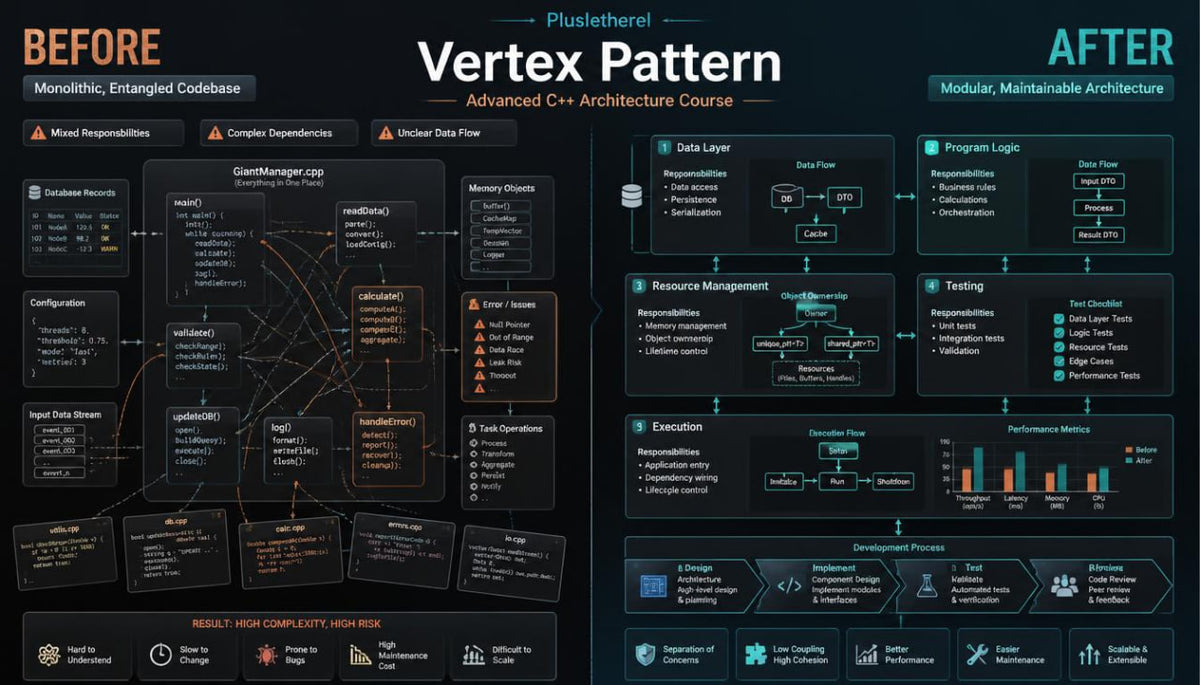
As C++ learners begin working with larger programming structures, understanding individual language features becomes only one part of organizing a complete program. Combining classes, templates, data containers, memory management, and concurrent operations introduces complex relationships between components that must communicate and share responsibilities. Architectural decisions influence how information moves through a program, how resources are managed, and how changes to one component affect surrounding code. Performance analysis, error handling, and testing introduce additional considerations that require examining program behavior beyond individual instructions. Without an organized approach to these interconnected subjects, evaluating larger C++ codebases and understanding the reasoning behind their structure can become challenging.
2. Solution
Vertex Pattern presents an integrated approach to advanced C++ study through structured lessons examining architecture, component relationships, performance, and practical program design. Each module connects previously introduced language features with broader programming considerations and demonstrates their application through annotated examples. Guided exercises encourage learners to analyze architectural decisions, examine resource ownership, interpret performance measurements, and evaluate alternative implementations. The materials introduce systematic methods for reviewing program behavior, organizing testing activities, and documenting relationships between components. A concluding programming assignment brings together multiple course subjects within a connected C++ application designed for technical examination and independent practice.
3. What's Inside
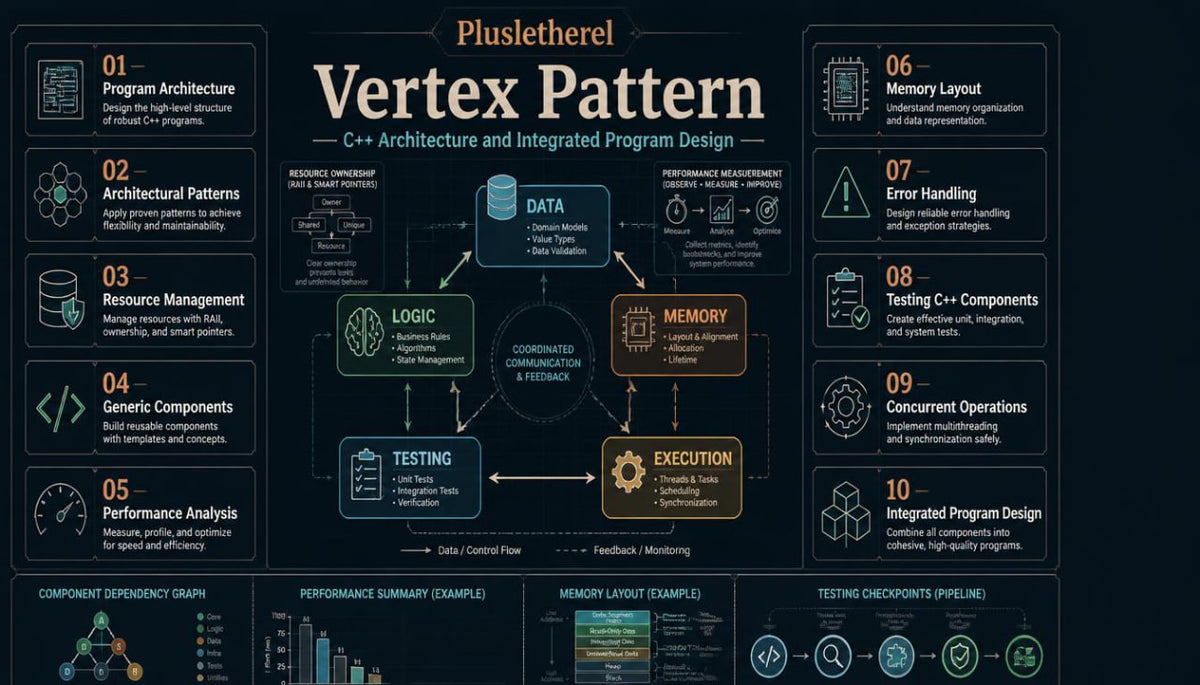
Vertex Pattern contains ten instructional modules covering advanced C++ programming structures, software architecture, performance evaluation, resource coordination, and integrated program development.
The curriculum includes detailed written lessons, annotated code examples, architectural illustrations, technical reference notes, review worksheets, and a concluding programming assignment.
Module 01 — Thinking Beyond Individual Functions
The opening module examines how larger C++ programs are divided into interconnected components.
Learners explore component responsibilities, interfaces, dependencies, and the relationship between local implementation details and broader program organization.
Examples demonstrate how a larger programming task can be divided into smaller sections with clearly defined purposes.
The materials introduce cohesion and coupling as concepts for examining relationships between program components.
A guided activity invites learners to analyze an existing program structure and describe how information moves between its components.
Module 02 — Architectural Patterns in C++
This module introduces selected architectural patterns and the reasoning behind their use.
Learners examine approaches such as factory-based object creation, strategy-based behavior selection, and observer-style communication.
Annotated examples demonstrate how these arrangements organize responsibilities between classes.
The module emphasizes interpreting the problems addressed by each pattern and the additional complexity that a particular arrangement may introduce.
Practical exercises involve comparing different architectural approaches to the same programming task.
Module 03 — Resource Management Across Components
Managing resources becomes more involved when several components interact.
This section revisits RAII, smart pointers, object lifetime, and ownership relationships within larger programs.
Learners examine situations involving shared objects, transferred ownership, and resource cleanup across component boundaries.
Examples illustrate how ownership decisions influence interfaces and object relationships.
A dedicated worksheet asks learners to trace object lifetimes and identify which program components are responsible for managing particular resources.
Module 04 — Generic Architecture and Reusable Components
This module examines how templates and generic programming techniques contribute to reusable program structures.
Learners explore template-based interfaces, constrained operations, and relationships between generic components.
Annotated examples demonstrate how different data types can participate in shared processing operations.
The lessons also examine situations where generic programming introduces additional complexity.
Practice activities invite learners to interpret template-based components and describe their type requirements.
Module 05 — Performance Measurement and Code Behavior
Performance analysis provides information about how programs use computational resources.
This module introduces execution-time measurement, computational complexity, and the interpretation of performance observations.
Learners examine examples involving repeated operations, collection traversal, and alternative data-processing strategies.
The materials discuss the importance of comparing equivalent operations under documented conditions.
Exercises involve interpreting measurement results and considering how algorithm choice and data organization influence program behavior.
Module 06 — Memory Layout and Data Organization
This section examines the relationship between data representation and memory behavior.
Topics include object layout, contiguous storage, data locality, and the structural characteristics of selected C++ containers.
Learners compare examples involving different approaches to storing related information.
The module discusses how allocation patterns and memory organization can influence program execution.
Annotated diagrams illustrate relationships between objects, collections, and memory regions.
Module 07 — Error Handling and Program Reliability
Larger programs require clearly defined approaches to handling invalid information and unexpected conditions.
Learners examine exceptions, error categories, validation rules, and the responsibilities of different program components.
Examples demonstrate how errors can be represented and communicated between functions and classes.
The module also introduces exception-safety considerations and the relationship between resource management and error handling.
Practice activities involve reviewing programming examples and identifying how errors move through interconnected components.
Module 08 — Testing and Reviewing C++ Components
This module introduces structured testing concepts for examining program behavior.
Learners explore test cases, expected results, boundary conditions, and the distinction between testing isolated components and testing their interactions.
Annotated examples demonstrate simple assertions and organized test scenarios.
The materials explain how tests can document intended behavior and identify differences between expected and observed results.
A guided worksheet invites learners to design test cases for functions, classes, and small processing components.
Module 09 — Coordinating Data and Concurrent Operations
This section revisits concurrent programming within the context of larger C++ structures.
Learners examine how threads, synchronized collections, and shared resources interact across component boundaries.
Examples demonstrate task processing, ownership of shared information, and the coordination of program shutdown.
The module also discusses how architectural choices influence synchronization requirements.
Review exercises involve tracing concurrent operations and identifying responsibilities for shared-state management.
Module 10 — Integrated C++ Program Architecture
The concluding module brings the curriculum together through a structured application study.
Learners examine a data-processing application containing several cooperating components responsible for record storage, processing, validation, and reporting.
The example combines custom classes, standard library containers, generic functions, resource ownership, and selected concurrent operations.
Written guidance divides the application into architectural planning, component implementation, data processing, error handling, and testing activities.
The concluding assignment invites learners to design a related application structure and document the responsibilities of its individual components.
Additional Course Materials
Vertex Pattern includes supporting educational resources organized around the instructional modules:
-
Annotated Architecture Examples: Detailed explanations of connected C++ components.
-
Component Relationship Diagrams: Illustrations showing interfaces, dependencies, and data movement.
-
Resource Ownership Worksheets: Exercises examining object lifetime and ownership boundaries.
-
Generic Programming Notes: References covering templates, type constraints, and reusable components.
-
Performance Analysis Activities: Exercises comparing operations and interpreting measurements.
-
Memory Organization Diagrams: Illustrations of data layout and allocation relationships.
-
Error Handling Exercises: Activities involving validation, exceptions, and component interaction.
-
Testing Worksheets: Tasks focused on expected behavior and boundary conditions.
-
Architecture Review Questions: Written prompts examining design decisions and alternative approaches.
-
Integrated Programming Assignment: A connected application study combining the course's principal technical subjects.
4. Who Is This For?
Learners With an Established C++ Foundation
Vertex Pattern is intended for individuals familiar with object-oriented programming, templates, standard library containers, and resource management.
Students Interested in Larger Program Structures
The course may suit learners who want to examine relationships between multiple components rather than studying individual language features separately.
Readers Exploring Architecture and Performance
The materials provide opportunities to examine program organization, performance measurements, memory behavior, and architectural decisions.
Individuals Studying Resource Coordination
Learners interested in ownership relationships, error handling, testing, and concurrent operations can explore how these concepts interact within connected programming structures.
Independent Learners Working Through Technical Examples
The written curriculum supports individuals who prefer examining detailed code, diagrams, and practical assignments according to their own schedules.
5. What You'll Learn
Through the course materials and practical activities, learners can explore the following C++ concepts and technical skills:
-
Analyze the architectural structure of a multi-component C++ program.
-
Identify responsibilities and dependencies between classes and modules.
-
Examine selected architectural and object-oriented design patterns.
-
Compare alternative approaches to component organization.
-
Interpret resource ownership across class and function boundaries.
-
Apply RAII concepts when examining resource-management structures.
-
Explore reusable components through templates and generic interfaces.
-
Describe how container choice and data organization influence program behavior.
-
Interpret execution-time measurements and introductory complexity analysis.
-
Examine relationships between memory layout and data processing.
-
Identify error-handling responsibilities within connected components.
-
Explore exception-safety considerations and validation techniques.
-
Design test cases for functions and class-based components.
-
Examine boundary conditions and expected program behavior.
-
Interpret synchronization requirements in concurrent programming structures.
-
Analyze communication between data-processing components.
-
Document component responsibilities and relationships.
-
Combine architectural, memory, algorithmic, and testing concepts within an integrated programming assignment.
The curriculum emphasizes technical reasoning, program organization, and the examination of interconnected C++ mechanisms.
6. 30-Day Refund Policy
Vertex Pattern includes a 30-day refund request period.
Customers may submit a refund request within 30 days of purchasing the course, subject to the conditions described in the published Plusletherel Refund Policy.
The policy outlines the procedure for requesting a refund, applicable eligibility requirements, and how submitted requests are reviewed.
Customers are encouraged to examine the curriculum, recommended previous knowledge, and included educational materials before completing an order.
The 30-day arrangement concerns the terms of purchase and does not establish commitments regarding individual educational outcomes, completion schedules, or employment opportunities.
Vertex Pattern is intended for independent C++ programming education through detailed written lessons, technical references, annotated examples, and practical assignments. Individual progress depends on previous knowledge, study time, and engagement with the course materials.
- 📥 Digital file available after purchase
- 📚 Long-term availability
- 🔒 Secure checkout
- 📅 Content updated in 2026
Self-paced learning overview
What is included in a Plusletherel C++ course?
What is included in a Plusletherel C++ course?
Each course contains structured educational materials focused on selected C++ programming topics. Depending on the course tier, the materials may include written lessons, code examples, guided exercises, reference notes, and practical assignments. Individual course descriptions provide details about the subjects and learning activities included.
Can I study the materials at my own pace?
Can I study the materials at my own pace?
Yes. Plusletherel courses are designed for independent study, allowing learners to read explanations, examine programming examples, and revisit previous sections according to their own schedules. You can spend additional time exploring individual concepts before moving to another topic.
How do the different course tiers compare?
How do the different course tiers compare?
The course collection follows a gradual progression from introductory programming concepts to more detailed C++ topics. Each tier introduces a particular selection of subjects, exercises, and educational materials. Learners can review the curriculum of each course to identify the topics that correspond to their existing knowledge and interests.
Share